AI agents: soon a virtual colleague
AI agents, coming soon as your colleague
You thought you’d seen it all with voice clones, deepfakes, and 100% AI-generated films.
Well, brace yourself: soon you’ll have an AI as a colleague or assistant, one that answers your emails and schedules your appointments. Literally.
Better yet: you’re probably paying hundreds, thousands, even tens of thousands of dollars a year in software. Within 5 years, thanks to AI agents, you’ll be able to recreate almost any piece of software yourself for a fraction of the price.
So, 2025 is shaping up to be the year AI agents emerge
AI heavyweights like Anthropic, OpenAI, Nvidia, and Salesforce are saying it loud and clear: 2025 is the year AI agents become reality.
Jensen Huang, Nvidia’s CEO, even announced it officially: “This year we’re going to see it take off.” OpenAI’s Sam Altman goes even further, arguing we’ll see “the first AI agents join the workforce” as early as 2025.

So, what exactly is an AI agent?
Unlike a chatbot that you ask a question (like ChatGPT) and that answers you, an AI agent acts on its own. Among other things, it can:
- browse the web;
- fill out forms;
- click, type text, scroll;
- write code;
- launch marketing campaigns;
- plan complex tasks;
- etc.
In short, it doesn’t just understand instructions — it takes initiative in a digital environment.
Back in October, Anthropic had already given us a preview: Claude AI managed to control a PC… clicking, scrolling, typing, basically like a human. The results were far from perfect, but you could already see the early signs of automation. Claude was able to see a screen, manipulate the interface, and so on.
Why does this matter to us, communications people and content creators?
The promise of AI agents is tempting: delegate repetitive tasks to a virtual colleague so you can focus on what matters most — storytelling, strategy, creation.
Imagine:
- Your AI agent works on the editorial angle, digs through trends, and produces a script or shoot plan.
- Your agent combs through the data, runs analyses, and identifies gaps in your existing content.
- It sends emails, books Zoom meetings, and handles collecting video footage.
- The agent schedules distribution on YouTube, Facebook, and LinkedIn, compiles performance stats, and puts together a numbers-based report for you.
This isn’t just another version of ChatGPT. AI agents are the famous “next step” of AI. Agents no longer wait for a prompt to carry out an action. They integrate multiple tools (web browser, CRM, various SaaS platforms, social networks, etc.) and manage multi-step tasks.
For example, you could delegate to it the task of finding a speaker for a webinar, negotiating their availability, sending a contract, booking the virtual room, and sharing the agenda with participants.
That said, in 2025 the use cases will probably still be fairly simple, with somewhat clumsy execution. The examples floating around are honestly a bit lame — booking a flight or ordering an Uber. But the more they learn, the more they’ll take over entire processes from start to finish.
OpenAI: Operator and Deep Research
OpenAI obviously wasn’t going to let the competition get ahead. They recently announced the launch of two tools marking the start of the agent era: Operator and Deep Research (an equivalent of the latter was already available through Google’s Gemini, by the way).
In short, Operator is a bit like Anthropic’s Claude AI agent. It can, say, fill out forms, make online purchases, or even generate memes (yes, it’s in the demo).
As for Deep Research, it’s like a research assistant. It’s a smart engine that autonomously digs through databases or the web. You give it a research assignment, and it takes up to 30 minutes to build you a full report.
Replit, Cursor, GitHub & co.: coding as we know it is over
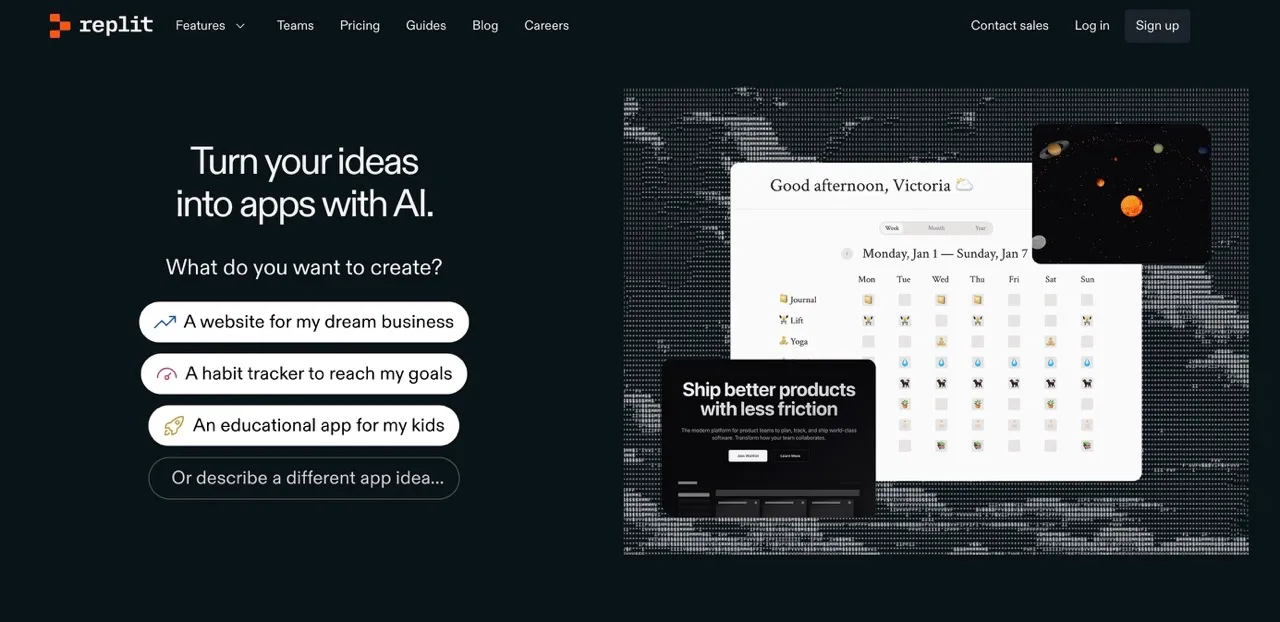
Personally, I find the most fascinating AI agents are the ones that code for you. Already, agents from Replit, Cursor, or GitHub Copilot can write code automatically from a prompt. I even tried it myself with GPT o3-mini-high, which coded me a simple application microsite in 30 minutes (and about twenty back-and-forths).
Today, these tools already help developers save time, but within a year or two, we’re talking about agents that will actually code, test, and deploy apps without a human ever touching the keyboard.
How will this change the game in marketing and creation?
#1 – Content production, assisted to the max
- The AI agent will scan a blog, spot the topics that work, analyze TikTok trends, and come up with 3 podcast episode ideas.
- It’ll draft articles or LinkedIn posts while sticking to a given tone. That’s already doable today, but by 2025 it’ll be even more refined, more consistent, and faster.
- Assisted video editing? Why not. We’re already seeing AIs capable of automatic cuts, adding subtitles, and so on. An AI agent could sync all of that within a project management system, tag your footage, create a mini-teaser, and more.
#2 – On-the-fly performance analysis
Marketers will spend less time on Google Analytics or Meta Ads Manager: the AI agent will analyze the data itself, identify problems (ad costs too high, CTR dropping…), and make adjustments on its own.
#3 – All-in-one scheduling and publishing
We already do this with tools like Hootsuite or Agorapulse. But an AI agent could go even further:
- spotting the best time to post;
- checking that the visual is in the right format;
- adapting the copywriting depending on the channel (TikTok, LinkedIn, Instagram…);
- replying to the first comments to kick off the conversation.
#4 – Client management and prospecting
An AI agent connected to a CRM (HubSpot, Salesforce…) could generate personalized follow-up emails, book meetings, take notes, and more.
The challenges for 2025 are massive.
First, the multimodal side of things is still limited. If an AI agent has to “see” a PDF, “read” an Excel spreadsheet, “listen” to an audio clip, and “talk” to a CRM… coordinating all that is still tricky for it. That’s why the giants (Google, OpenAI) are working hard on multimodality. Eventually we’ll reach a point where an agent can analyze text, images, and video all at once.
Then there’s what’s called “contextual deafness.” An AI agent doesn’t always have access to a project’s full history. You need to give it the right knowledge base, or it’ll go off the rails.
How to prepare and get started
Your competitors, your rivals, or your colleagues won’t hesitate to test out these agents, streamline content production, scale up A/B testing, and so on. If you don’t explore this at least a little, you risk missing out on innovations and working in 2024 mode while others have already shifted into a higher gear.
A few ideas to get started:
- Test small tools: Try an AI agent for simple tasks (e.g., scheduling a shoot, generating a summary). See if it actually helps or if you end up spending more time fixing its mistakes.
- Keep humans at the center: The agent proposes, you validate. There’s no question of letting it act without supervision, especially for strategic or creative decisions.
- Train your team: Juniors and seniors alike need to understand how AI thinks, know how to give clear instructions, and incorporate feedback.
- Set up security protocols: Who grants access? To which tools? How do you control data usage?
- Finally, stay in the loop (by staying subscribed, for one).
How to get started?
Step 1: a quick internal audit
- List your most repetitive and time-consuming marketing/creative tasks.
- Assess whether automating them with an AI agent is feasible.
Step 2: pick a test tool
- Try a consumer-facing AI agent: OpenAI Operator, Anthropic’s Claude, or more specialized solutions (e.g., Cursor for code).
- Set it up for one specific task.
Step 3: put up guardrails
- Don’t give it access to all your data at once.
- Track its actions, and keep veto power at each key step (e.g., publishing a post).
Step 4: gather insights
- Note where the AI messed up and what it did well.
- See if the time savings are real, or if you’re spending more time correcting its work.
Step 5: iterate… or abandon ship
- If it works out, expand its use to other processes.
- If it flops, revisit the setup or try a different agent.
What to expect in 2025… and beyond?
The next models (Claude 3.5 Sonnet, GPT-5, etc.) will probably be able to edit video sequences, manage a marketing funnel from A to Z, or even launch an app online. Why not an AI agent that talks directly to your suppliers, compares offers, negotiates prices, and signs contracts?
In the future, you might even have a virtual-reality “AI assistant” that follows you on shoots and suggests the best camera angle, and more.