The Stand-Up Meeting: How to Be Efficient at Work
Endless, pointless meetings are a thing of the past. Here's our recipe for being efficient

Every one of our days starts the same way: with a meeting of the whole team. We can already picture you reaching for your meeting-overload alarm.
And fair enough—meetings aren’t always a party: sometimes you wonder if they’re really necessary, and they often run longer than planned. Meanwhile, your to-do list isn’t getting any shorter.
That said, we’ve found a way to make ours efficient while still building team cohesion: we run our morning meetings as stand-up meetings. Interested? Here’s our recipe for success.

A clear, defined meeting topic
This meeting exists mainly so everyone can check in on their current projects and files. But instead of giving a full rundown of what’s been done, what’s left to do, and what needs to happen this week or on a given project, we decided to focus only on our priorities for the day. We can also share challenges or roadblocks and ask a colleague for help. That said, if we need to follow up internally on a project or ask a specific question, that calls for a separate meeting with the people involved. Another essential part of this meeting is a shout-out—personal or professional. The idea is to build more cohesion among us and learn more about our coworkers. A few examples of shout-outs:
- I got my sense of taste back after having COVID!
- Shout-out to Mehdi for how quickly he responded on our project yesterday.
- It’s nice out today! (When we’re out of ideas, that’s our go-to shout-out 😅)
The length
First things first: you need to set a length for the meeting. Since we’re a small team of 6, we decided 15 minutes would be more than enough. With our method well established, it’s actually rare for us to use the full time slot.
These 15 minutes apply to every stand-up meeting. And, as mentioned above, if we need to discuss something related to a specific project, we set up a separate meeting—because what we want here is a quick check-in!

The format
In a traditional meeting, there’s always one person leading the discussion. For our morning meetings, we chose to do things differently. The last person to arrive at the meeting starts. Once they’ve shared their shout-out and priorities, they hand the floor to whoever they choose. It’s that simple!
That said, we always have someone whose job is to rein everyone back in when we get too deep into details or wander off topic. At Sparkling, that’s usually David. ⌚ Whether we’re all in the office or working remotely, the format stays the same. The only difference is that when we’re in the office, we hold this meeting… standing up!
It’s not called a stand-up meeting for nothing! The original idea is that standing up tires you out faster, so you become even more efficient and get straight to the point. It’s also a technique favored for conflict resolution (though we haven’t needed that one!).
The benefits of the stand-up meeting
Sparkling is a marketing and communications agency, so it’s only natural that internal communication matters a lot to us too.
Having this little 15-minute check-in every day helps us understand how the various projects are progressing and what our colleagues are working on. For example, we know when Amy is preparing content for Sparkling’s social media, so we can send her our suggestions. It also lets us know everyone’s availability: if David declares an accounting day, we know we’ll have a bit less access to him. And finally, it lets us see if one of our colleagues is overloaded with a project. In that case, we can offer to lend a hand 🤝
On a more personal note, we also like learning a bit more about our colleagues. Anne-Catherine often announces a win from the night before for the Félines, the Rioux-Pieropan girls’ baseball team! Sophie recently shared as her shout-out that she’d bought herself a third horse. As you can see, it really goes in all kinds of directions!
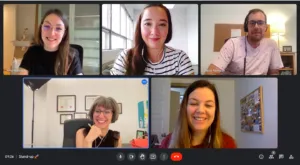
We lost those little “water cooler” conversations because of the pandemic, yet they’re essential to good relationships between coworkers and to building close-knit teams. We’ve recreated a bit of that in these morning meetings.
As you can see, this kind of meeting has plenty of benefits. For our team, they create a sense of belonging among team members, help us build connections, keep us informed about what’s happening within the company, let us share essential information out loud (not through yet another email…), and help us start the day engaged and motivated. That’s no small thing in the age of remote work, when it’s hard to get everyone together in the office at the same time. If you’d like to bring this kind of meeting to your own workplace, shape it to your own needs and criteria. A recipe is meant to be adjusted to taste! 😉
READ ALSO: The 5 important rules for a successful brainstorm