How to Create Good Content? A Few Reminders From the FWCC
Creating good content is our specialty. Here's our guide to help you

Content marketing is our specialty. Being a specialist in something means knowing your stuff, having access to a diverse and skilled team and plenty of resources, but above all, it means staying on top of trends and developments in the field. Last month, I spent a week rubbing shoulders with various experts at the Festival Web de Création de Contenu (FWCC), organized by Alexe Martel and her crew. It gave me a chance to refocus on what matters most in content creation. Here are a few of my notes from that inspiring week — with some personal additions — on how to create good content.
Heads up! This article is for you if you already have a basic grasp of marketing vocabulary and common practices.
How to create content intentionally?
Tatiana St-Louis draws a distinction between the traditional, instrumentalizing approach to content (where a sender produces information received by an audience) and intentional content creation. It’s an interesting perspective that lets you see content as a space for dialogue and exchange with the recipient of your message.
For her, content should be relevant (positioning itself as an expert guide), coherent (aligned with our brand), consistent (being a leader with a clear message), and should hold onto these qualities over the long run.
When you create content every day, it’s easy to fall into habits, clichés, repetition.
It’s important to always remember why you’re creating — and, more importantly, for whom.
Are you scribbling or are you creating? Does your content bring value? What’s its purpose?

Copy or draw inspiration? How to create content ethically?
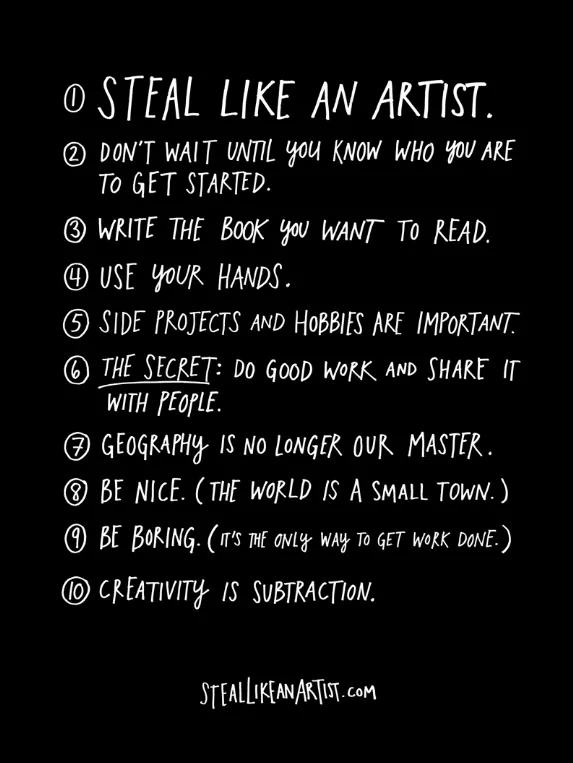
We’re all thieves. No idea is ever completely original. That said, there’s a big difference between plagiarism and inspiration.
Jolianne Landry’s compost allegory:
1— We consume content we like, from various sources.
2— We digest the information. It matures in our minds, we add other inspirations to it, and we make a nice mush out of all our inspirations.
3— We fertilize: we spread our lovely mush of ideas all around to help other ideas germinate.
That’s kind of what we do at Sparkling: each of us has our own moodboard and sources of inspiration. We regularly share things we’ve liked with each other, creating a collective mush that sparks new ideas for us!
A few resources to go further:
- Steal Like an Artist by Austin Kleon
- Everybody Writes by Ann Handley
SEO: positioning your digital content well
Creating content is one thing, but making it available to the people who are interested is another. You could write entire books on SEO and update them every week. It changes often, and you need to be quick to catch trends and updates. That said, it’s good to remember that:
- SEO isn’t just a string of keywords in your web URL or your written content. At its core, the content has to be good. For solid SEO, always think about offering a better experience to your target customer. How can you improve the user experience on your website? Clarify what you do? Guide people through your content?
- Your organic search ranking will be better if users share a specific link from your website (as opposed to your homepage, for example). Guide them toward high-value content pages and encourage them to share those.
Are you analyzing your results? If you rank really well on Google but nobody clicks on your links or reads your content once they’re on your site, what was the point of putting all that energy into your SEO?
What’s the future of content creation?
The FWCC wrapped up with a very interesting panel where several experts discussed the future of content creation. And no, it wasn’t about the best platforms to use, next year’s Pantone color trends, or the effects to include in your next TikTok video. The discussions focused more on the role of content creators within a communications and marketing ecosystem — and within society at large.
My takeaway from that panel is that the future of content creation lies in turning it into an approach and a craft built on solid foundations.
In my opinion, to be a good content creator, you need to find a balance between solid foundations (values, brand, workflow and strategy) and an openness to creativity and new ideas and approaches.
A few reminders to repeat to yourself when you create
- Being a content creator means being a real jack-of-all-trades: writer, scriptwriter, photographer, editor, marketer, and sometimes even actor.
- Think about creating a dialogue with the reader rather than simply presenting them with information.
- Content needs to be personalized. Again: who is your ideal customer, and what do they want?
- Is your content only on your social networks? Bring it home to a platform you own, like your website!
- Stand out. What’s your added value? Why should someone choose YOU as their content creator?
- Always stay connected to your brand.
- Writing something? Read it aloud before publishing (the trick Alexe repeats all the time, but it’s so relevant!)
Are you a content creator? How do you see the future of content creation? What are your biggest challenges?