Marketing vocabulary lexicon
Marketing changes all the time. No wonder it gets confusing!

Working with us means your projects will be clear, simple and fun. In other words, we make sure you understand what we’re doing and why we’re doing it. What we want is for you to look like this:

So we put together a little lexicon for you, organized by theme. Whether it’s translations and acronyms, concepts or technical vocabulary, it’s probably not complete, but we could improve this lexicon together! Reach out if you’re looking for other definitions.
Reading key: if you see an asterisk* next to a word, that means its definition is included a bit further down in this lexicon!
Strategy and content
This section covers words and expressions used in content marketing, particularly when it comes to building communication and content strategies.
Affiliation: affiliate marketing aims to boost sales of products or services. For example, someone with influence in the fashion world might offer their community, through an agreement with a company, an affiliate link to that company’s site for a new handbag (often tied to a launch or a promotion). Every time a sale is made through that link, the influencer earns a monetary commission.
Audience: refers to a target public for a given piece of content or platform. For example, the people signed up for your newsletter form an audience, while the followers of a Facebook page form another. You wouldn’t address them the same way. Not to be confused with target public or persona*. An audience can be made up of several personas.
Automation: refers to a number of actions or processes that can be automated with various digital tools. For example, newsletter software lets you automatically send a welcome email to anyone who newly signs up for your mailing lists.
Chatbot: a program that automates responses to frequent questions, often used on social media or online stores to handle direct messages without human intervention.
Clickbait: literally “click bait.” Often used pejoratively to describe bad marketing or misleading content. For example, headlines like “You’ve never seen this celebrity from this angle!” attract clicks but often disappoint with content stuffed full of ads and… not nearly as impressive as promised!

CTA: short for Call to Action. Consumers are encouraged to take action in various ways, for example by putting “Contact us” at the bottom of a blog post or adding a “Sign up” button at the bottom of a landing page*.
Earned / Owned / Paid Media: media or channels that are earned, owned or paid. Local newspapers are paid media when you buy an ad in them. A business’s website or storefront are owned media, belonging to that business. The notion of earned media is more variable, but generally refers to communication channels obtained through various actions, like partnerships with other brands or shares that expose us to new audiences.
Evergreen: literally “always green.” Refers to content that stays valid, relevant and reusable over time. For example, for a shoe design company, it will always be relevant to remind customers how to properly measure their foot to determine their size.
Followers: refers to subscribers on a communication channel like a social network. Followers are a form of consumer.
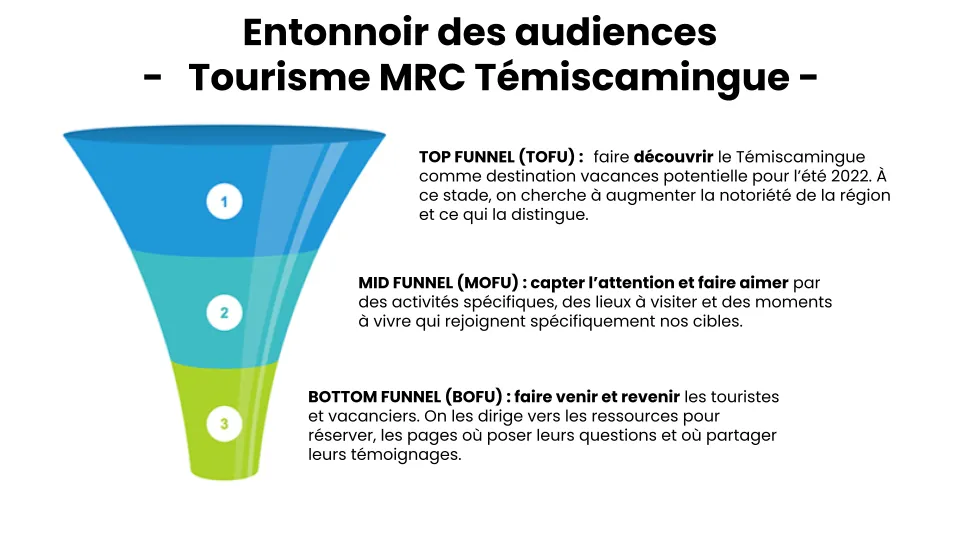
Funnel: the principle of moving from the broadest to the most precise. In the example below, we built an audience funnel because we wanted to introduce potential tourists to the Témiscamingue region. The funnel lets us visualize and illustrate our strategy, which was different for each stage of the funnel.
Landing page: a bit like a website, but with a single subject or objective. For example, a company might create a landing page for a one-time event it’s organizing, with branding different from the company’s own. Often used for sign-up pages, contests or programming. Read our article to learn more.
Lead: a term generally referring to a prospect, a target. We usually talk about leads as potential customers or opportunities.
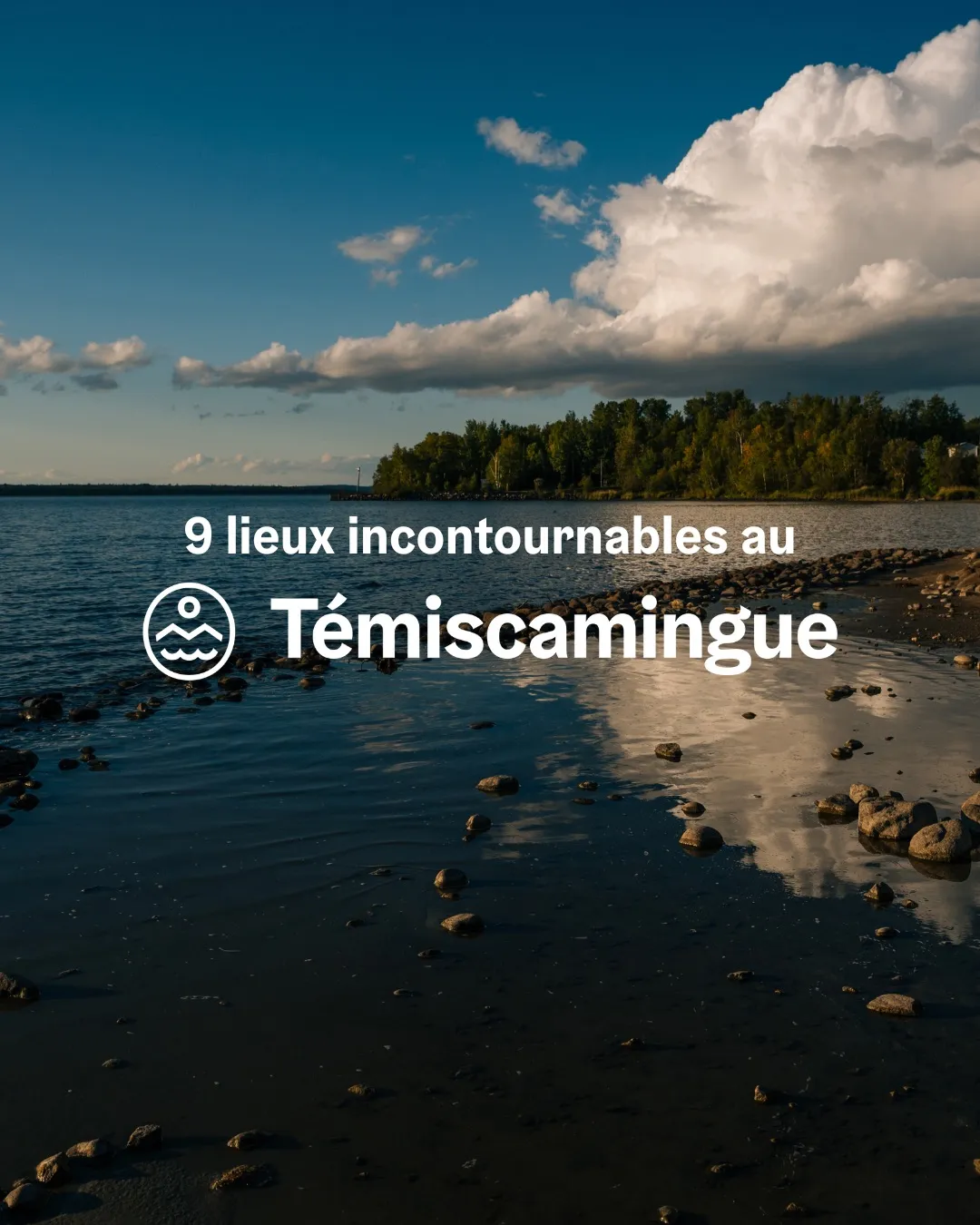
Lead magnet: a tool, product or piece of content designed to attract potential customers. For example, we attracted new sign-ups to the Témiscamingue RCM’s newsletter by offering a list of 9 must-see spots in the region in exchange for signing up. An Instagram contest would also be a lead magnet for attracting new followers*.
Organic: the opposite of sponsored* content, organic content is distributed naturally, without advertising. Posting an image on Instagram is organic. Someone sharing that image is also organic. Persona: like a composite sketch of the ideal customer. When you build a persona for your business or brand, you think about their consumption habits, desires, challenges and routines, with the goal of meeting their needs through your communications. It’s an exercise we recommend everyone do!
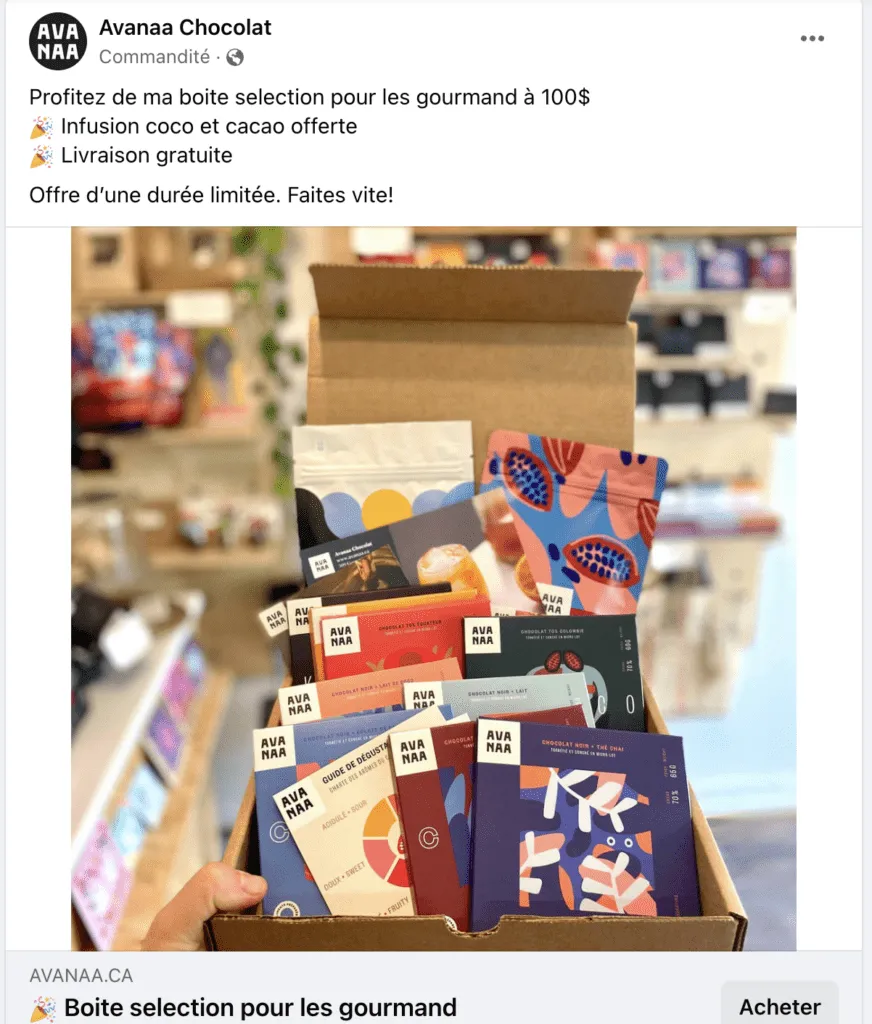
Sponsored: on digital platforms, sponsored content is content whose distribution has been paid for. For example, this Facebook post:
UGC: short for user generated content. Content generated by users is very valuable to businesses since it lends credibility to their product and feeds their content bank for free, or almost. For example, positive testimonials left on a website by a customer or unboxing-style videos on social media are forms of UGC.
White paper: an expert article on a specific topic, created with the goal of informing, educating or guiding a reader who wants to learn about a subject.
Technical vocabulary
The following terms, mostly in English or acronyms, refer to technical aspects you might encounter in content marketing, particularly when building a website.
Backend: the behind-the-scenes part of a website, for example. It’s the part the user or consumer doesn’t see. For example, if a client wants to change the color of a section of their website, we might say we’re going to go make changes in the backend.
Backlink: a term used in SEO that refers to a link pointing back to a given site. For example, if your website is mentioned on a partner’s website, it’s possible to analyze how many clicks to your site come from that specific backlink.
Backlog: a set of tasks or pieces of information needed to accomplish a project.
CMS: short for content management system. The best-known CMSs include WordPress, Wix, Shopify and SquareSpace. These are software or tools that make it possible to present content in an accessible way. Thanks to them, anyone can easily create a website or online store since they handle the web development tasks for us, without our needing to understand the technical vocabulary. They’re usually full-featured and versatile thanks to integrations with complementary software.
CRM: short for Customer Relationship Management. A CRM refers to software that stores data about a business’s customers and makes it possible to analyze that data to then take action toward those customers based on their consumption habits and their communications with the business. For example, a theater company could schedule the sending of a promo code to encourage anyone who hasn’t bought a ticket in over a year to come see a show. This creates personalized touchpoints based on each person’s needs and habits.
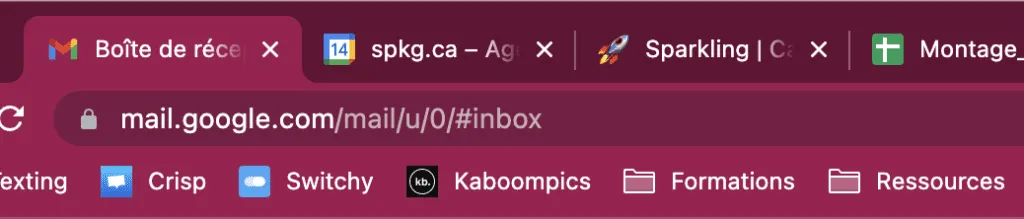
Favicon: an icon that represents a website. You’ll find it in the browser’s navigation bar and bookmarks. In this example, you’ll surely recognize the Gmail inbox, Google Calendar and Google Sheets.
Opt-in / opt-out: the action of obtaining (opt-in) or losing (opt-out) a person’s consent to send them advertising. Since the introduction of Canada’s anti-spam legislation, every business is required to have obtained a person’s tacit or explicit consent before being able to send them advertising-related information.
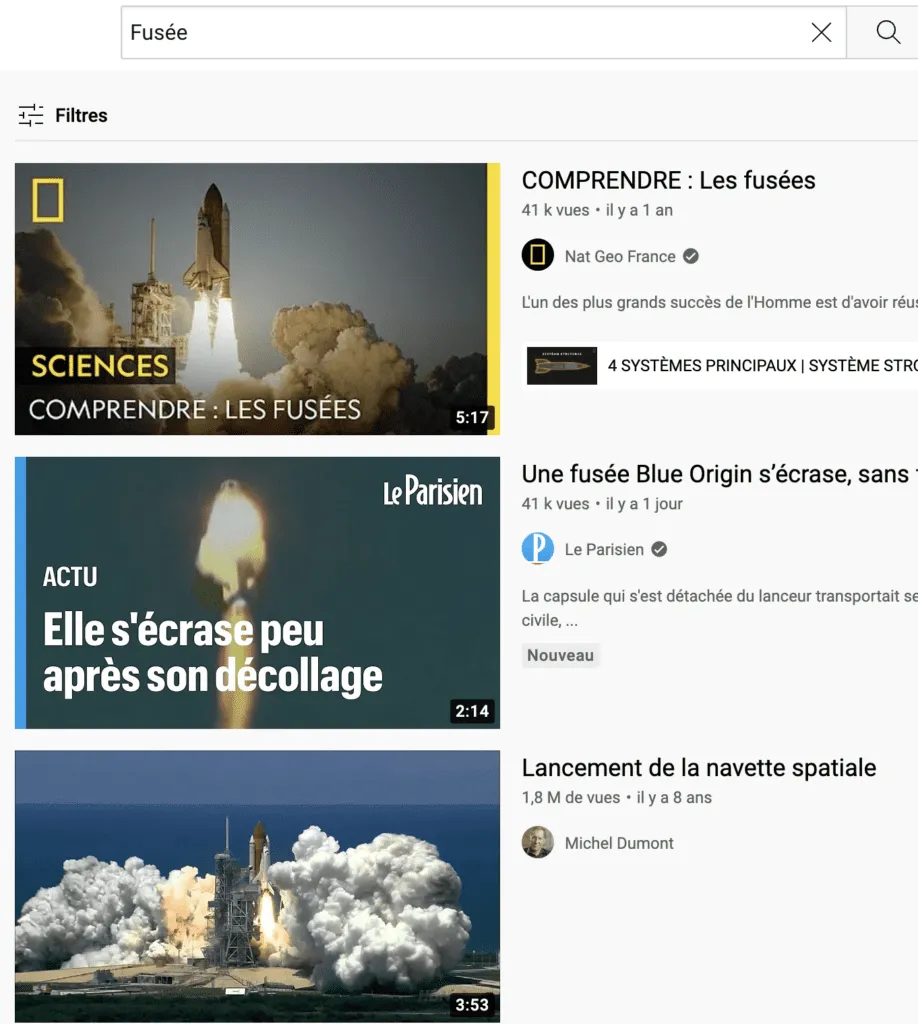
Thumbnail: refers to the small-format representation of a larger image or piece of visual content (in terms of quality). Thumbnails generally make it possible to identify content in a database or list, for example. The images shown in a Google Images search are thumbnails leading to the main image. The images shown on YouTube are also visual representations of the content of the video being suggested.
UTM: short for Urchin Tracking Module. It’s a set of parameters attached to a hyperlink to gather analytics data. For example, you can configure a “UTM link” for a specific ad campaign to measure how many clicks on that link came from that particular advertising source.
Wireframe: a functional mockup or diagram used in web design to guide a graphic designer in creating the visual interface.
Analytics
Creating content is great, but if you don’t analyze its performance, you don’t grow. Results analysis is full of technical terms and anglicisms worth understanding.
CPM: short for cost per mille, or cost per thousand. Refers to the acquisition cost of 1,000 ad impressions*.
Engagement: refers to a person’s interaction with a piece of content. Every time someone clicks on a post, shares it or comments on it, the engagement rate for that post goes up. Compared against the number of impressions*.
Hashtag: a keyword used as such thanks to the addition of the # symbol before it, making it recognizable to search engines.
Impressions: the number of impressions refers to the number of times a piece of content has been seen by someone. For example, on Instagram, every time a post appears in someone’s news feed counts as an impression.
Insights: an overview or information obtained. An insight is what you get after analyzing the performance results of a piece of content.
KPI: short for Key Performance Indicators. Before diving into an analysis, you always want to identify your KPIs, since the indicators used depend on the goals of an ad or content campaign.
ROI: short for Return on Investment. Generally used in advertising, it makes it possible to assess whether an ad performed well or not.
Concepts and approaches
These abbreviations refer to approaches or concepts that are part of, or complementary to, actions associated with marketing.
PR: Public Relations. Defines a set of strategic communication practices based on the relationship between a company’s representative (the PR person) and the public. For example, cultural businesses generally launch a big press relations campaign around the premieres of new shows or exhibitions in order to boost awareness of the cultural product and attract new audiences.
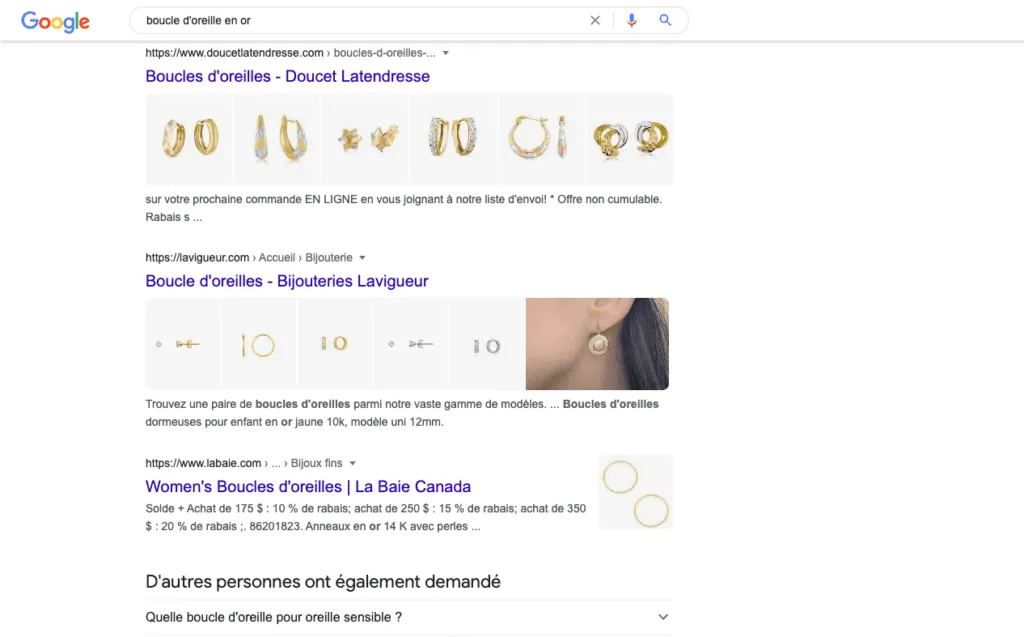
SEO: short for Search Engine Optimization. Covers a range of strategic practices aimed at ensuring good visibility for content on search engines. In this example, Bijouteries Lavigueur ranks well for the topic “o-shaped earrings” on Google.
SEM: short for Search Engine Marketing. As opposed to natural or organic SEO, SEM refers to the full range of practices available to optimize visibility through paid marketing actions, mainly advertising.
UX / UI: refers to User Experience and User Interface. The former is often dependent on the latter being well designed and built. The interface refers to the point of contact between a human and a piece of content, for example the device itself or a website, an app or software, while the experience refers to the user’s satisfaction or dissatisfaction with the interface and, therefore, with the content.
Phew, quite the read, huh? If you’re feeling tired, that’s normal. We want this lexicon to become a reference for you.
ALSO WORTH READING:
What is content marketing?
6 questions to ask yourself to write good content
Sticking the landing (page): the art of the landing page